
THE STUDENT SECTION
From the classroom to the community – students making their mark.
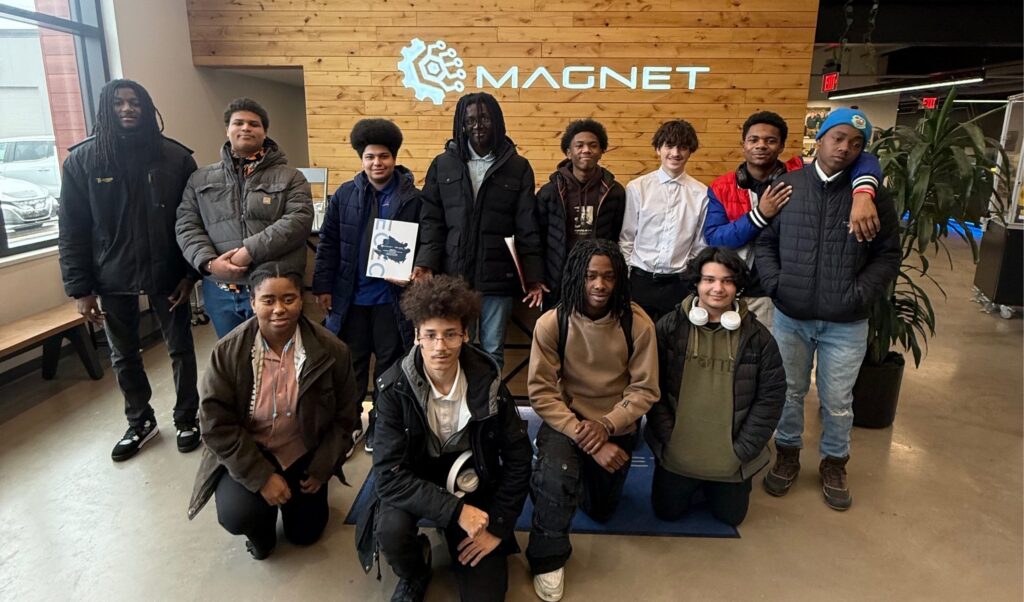
Paving Pathways: Empowering Students for the Workforce
Our work experience opportunities are fantastic ways for students to build their resumes and gain real-world exposure. We’re thrilled to share some of the updates about opportunities available to students:
We’re excited to announce the upcoming Summer Work Experience in partnership with Youth Opportunities Unlimited (YOU). In summer 2026, we will offer multiple paid positions that provide hands-on opportunities for students to developcritical job skills, gain professional experience, and explore various career paths.
Our first cohort of Early College Early Career (ECEC) juniors is entering their senior year, nearing the end of their two-year journey. Watching their growth, professionalism, and persistence has been truly inspiring, and we’re proud to celebrate all they’ve accomplished.
Our second cohort is taking shape. We now have 13 interested juniors preparing to begin the interview phase of the program. Over the coming weeks, we’re working on preparations—polishing interview skills, building confidence, and helping them represent themselves and Davis with pride. We can’t wait to see them shine and earn their spot in this incredible opportunity.
Celebrating Our Early Collece Early Career Seniors
It’s Early College Early Career time: the time of year we recognize and support our ECEC seniors. This year’s ECEC seniors, Tristan Johnson, Meairra Jackson, Edwin Romero, God Brooks, Camille Brooks, Genesis Cruz, and Noa Bazile, are about to begin the second year of their Magnet Program.
After gaining experience with Talon Products, Olympus Aerospace, and Euclid Heating over the summer, our students will now work with these companies on Fridays and at Magnet on Wednesdays. This will help them develop professional skills that will prepare them for entering the workforce upon graduation. We are looking forward to recruiting for the second round of Juniors in the upcoming months!
There’s a lot of exciting momentum building! Let’s continue supporting our students as they take big steps toward their futures.
Davis Students in ELA Explore the Rhetorical Devices Behind Dr. King’s Powerful Words
Mason and Sheyla, students in Ms. Burks’s English Language Arts class, recently completed a compare-and-contrast essay as part of the district’s new ELA curriculum. After reading Dr. Martin Luther King Jr.’s “I Have a Dream” speech and his “Letter from Birmingham Jail,” they wrote analytical essays examining how King uses rhetorical devices, including charged language, repetition, parallelism, and analogies, across both texts. Through this work, students deepened their understanding of persuasive writing while strengthening their own ability to recognize and analyze powerful rhetoric.
Sheyla Ruiz SantanA ELA – 9th grade

At times we as people might question, “How did that convince me to follow along with their plans?” That could be the use of rhetorics, parallelism, charged language, and repetition. Martin Luther King Jr. used those three ideas to convince huge groups of people to rise up against injustice for African Americans everywhere. Dr. King’s “Letter From Birmingham Jail” and the “I Have A Dream” speech both include parallelism, charged language, and repetition, but the speech deploys these three ideas more powerfully.
By analyzing the “I Have A Dream” speech and the “Letter From Birmingham Jail” it’s direct that the “I Have A Dream” speech uses parallelism better. As repeated many times during the speech, “One hundred years later” is an example of parallelism. Dr. King uses parallelism to carry the fact that even after 100 years, African Americans still didn’t have their rights. While the letter used parallelism in the form of, “When you/your…” to indicate the treatment of African Americans at the time. There’s a difference between the two which is that the letter is much weaker with staying on topic; switching between unfair treatment and segregation. By differentiating the speech to the letter, we can come to the understanding that the speech’s parallelism is more valuable than the letter.
Although both the “Letter From Birmingham Jail” and the “I Have A Dream” speech use repetition it’s shown more effectively in the “I Have A Dream” speech. The speech has one of the most popular phrases, “I have a dream..,”. Dr. King changed America due to his want for equal rights for everyone using just those four words. On the other hand, the letter uses, “If you were to watch…” as its form of repetition. Dr. King used that to highlight police cruelty against African Americans. Despite the fact that both the letter and the speech uses repetition, the speech applies it more powerfully.
A quick comparison between the “I Have A Dream” speech and the “Letter From Birmingham Jail” reveals that charged language is better used in the speech than the letter. In the speech, “This momentous decree is a great beacon light of hope to millions of Negro slaves who had been seared in the flames of withering injustice.” Dr. King backs up his arguments withstrong phrases, which is a perfect use of charged language. Using words like “grossly” and “ugly” would be another use of charged language. While the letter and the speech criticize African American treatment, the speech delivers a more powerful and stronger message with charged language.
In conclusion, both the “I Have A Dream” speech and the “Letter From Birmingham Jail” use parallelism, charged language, and repetition, but the speech uses all three better. The phrase in the speech “One hundred years…” uses the first appeal, parallelism, to explain that African Americans are still not free. The letter uses repetition to only talk about one race, while the speech talks about all. Charged language from the letter is influential, yet the speech calls to step towards action. The “I Have A Dream” speech uses rhetorical applications better, but the “Letter From Birmingham Jail” is still a very powerful letter.
MASON WESTWOOD ELA – 9TH GRADE

Government of the people, by the people, for the people, shall not perish from the Earth”, this was Abraham Lincoln’s speech in the “ 1863 Gettysburg Speech”, this makes you question how are these speeches so powerful?, let’s use the famous Martin Luther King’s “Letter from Birmingham Jail” and “ I Have a Dream Speech” as a compare and contrast representation. Listeners and readers don’t usually see the powerful and determined messages when rhetorical devices are specifically used in speeches, and even most of the time, they miss the main target points that the speaker is trying to convey and take action on. Rhetorical devices were used in Martin Luther King, Jr’s “Letter from Birmingham Jail” and the famous “ I Have a Dream Speech”, but the “ I Have a Dream Speech” uses rhetorical devices more effectively.
The rhetorical device of parallelism was used in Martin Luther King, Jr’s “ Letter from Birmingham Jail” and the “ I Have a Dream Speech”. But using parallelism techniques in the “ I Have a Dream Speech” brings a more powerful, unstoppable build of emotions to create constant rhythms. For instance, “ A just law is a man-made code that squares with the moral law or the law of God;, an unjust law is a code that is out of harmony with the moral law” is used in paragraph 16.
It can be concluded that a just law is one that aligns with more law, and or the law of God, while an unjust law contradicts it, and an unjust law is not a true law. “Letter from Birmingham Jail” doesn’t send a direct message and is not as powerful as the “ I Have a Dream Speech”. An additional piece of evidence in the “ I Have a Dream Speech” is the parallelism of “ I Have a Dream That” used by king in paragraph 17.
In this piece of evidence, he emphasized a more directly valued view in a more understandable way than “ Letter from Birmingham Jail” for America to be a better and more peaceful place without segregation or discrimination, to move ahead in a society where segregation and undeniable laws are no more. To summarize things, parallelism in “ I Have a Dream Speech” uses more strong emotional grammatical phrases to build rhythm, climax, and importance to move forward in a society where justice is for ALL.
Another rhetorical device repetition was used in Martin Luther King, Jr’s “Letter fromBirmingham Jail” and the “I Have a Dream Speech”, but although “ The Letter fromBirmingham Jail” is still emotional and persuasive, on the other hand “ I Have a Dream Speech”carries out repetition after repetition in a constant flow allowing for build up, as well adding more feeling and persuasiveness for all. For instance, in “Letter from Birmingham Jail,” the repeated repetition of “ I have” in paragraph 37. As a result, this shows that even though “Letter from Birmingham Jail” is still powerful and directs in its own way, it does not dominate theuseful repetition used in the other speech. The author states in “ I Have a Dream the repeated repetition “One Hundred Years later” used in paragraph 3. This shows the quote uses a voice of power and determination in order to bring segregation to a stop. Overall, “ I Have a Dream Speech” uses repetition in a more determined, powerful way to build emotional momentum and to unite under one to overcome many.
The final rhetorical device charged language was used in Martin Luther King, Jr’s “Letter from Birmingham Jail” and the “ I Have a Dream Speech”, but in the “Letter from Birmingham Jail”, King used charged language to put an immediate call to action in many people’s minds as well, putting a vivid image upon them therefore, “Letter from Birmingham Jail” represents a better alternative. For example, “ I Have a Dream Speech”, “The manacles of segregation and the chains of discrimination”. This shows the quote evokes images of slavery into people’s minds, despite the Emancipation Proclamation 100 years prior, African Americans were not free, but it does not top the “Letter from Birmingham Jail”. Another example is in “Letter from Birmingham Jail,” “ But when you have seen vicious mobs lynch your fathers and mothers at will and drown your brother and sisters at whim,” said in paragraph 14. As a result, King aims to provide detail to show the audience the harsh realities of racial hatred and oppression to the urgency of the Civil Rights movement, proving “Letter from Birmingham Jail” to be the most effective for the rhetorical device of charged language. To summarize, “Letter from Birmingham Jail” provides a detailed explanation of racial hatred and oppression, then pushes for people to come together and rise above the harsh realities of segregation and discrimination.
In conclusion, all of these rhetorical devices were used in Martin Luther King, Jr’s “Letter from Birmingham Jail” and the “ I Have a Dream Speech,” but “ I Have a Dream” uses rhetorical devices more effectively. Parallelism, charged language, and repetition are used beneficially, but the speech uses them more effectively. “One Hundred Years Ago” is an exemplary quote used by King to build more power and put rhythm into his speech, using one of these devices as well to overall persuade the audience using these said devices. Rhetorical devices are employed in many speeches to make communication more persuasive, memorable, and impactful while building rhythms and emotions along the way, while also connecting to the audience for additional buildup.